

California’s Supreme Court Pushed Back Against a Major Ballot Seizure
On February 26, armed deputies from the Riverside County Sheriff’s Department pulled up to the county registrar’s office and hauled off about 650,000 ballots from last November’s Prop 50 special election. Sheriff Chad Bianco, then running for governor, had a sealed warrant to investigate a “discrepancy” in the ballots (which the registrar had already fully explained at a public meeting).
Last Thursday, the California Supreme Court ruled 7-0 that the seizure was illegal.
I’m not surprised if you didn’t hear about it. The ruling got little attention, even from commentators who spent months warning that the Riverside seizure could become a new election sabotage playbook.
The playbook just got tossed out of court. The case turned on the plain language of California Elections Code: “[i]n no event” shall voted ballots “be taken from the custody of the elections official.” Chief Justice Patricia Guerrero, said the law intends “that ballots remain in the elections official’s custody even in the event of a criminal investigation.”
The opinion gives election lawyers and election officials everywhere new armor to protect elections this fall. The court explained that the code “contemplates that voted ballots remain in the continuous custody and control of elections officials from the moment the voter deposits them until the moment they are destroyed.” And it rejected Bianco’s “election integrity” argument: “allowing law enforcement unfettered access to ballots, or the ability to handle and count them in secret based on unregulated protocols, itself creates a substantial risk to election integrity.”
Justice Goodwin Liu’s concurrence offered: “Free and fair elections are the lifeblood of democracy. And election officials are the backbone of our electoral system.” He calls the ballots the deputies carted off “the most precious documents of the citizenry in a democracy: their votes.” He closes with a reminder that “every public official has an independent duty to follow the law. The judiciary serves as an essential backstop, but the rule of law depends in the first instance on the conscientious discharge of that duty by all officials.”
We Need to Celebrate the Riverside Win
Two weeks ago I wrote about why celebrating our wins matters. People join fights they believe they can win.
Riverside was won by people doing their everyday jobs well. Four voters refused to let a sheriff cart off their ballots, with the UCLA Voting Rights Project suing on their behalf. Registrar Art Tinoco, who has worked in that office since 2002, stood before his Board of Supervisors and explained how the vote count actually works. The county’s own lawyers wouldn’t represent its own sheriff.
Every one of those people sits somewhere within systems that authoritarians like Trump depend on for support (courts, officials, everyday voters), and every one of them held the line. If we skip past a win like this, we give in to the narrative of voter fraud and threats to elections. Celebrating the win vocally and visibly tells the next registrar handed a demand for ballots that we have her back.
Authoritarian Power Depends on Support from Across Society
No one rules alone. Gene Sharp built his work on that idea: power rests on the cooperation of many people, and power weakens when they withdraw it. We call those sources of cooperation “pillars of support,” including police, civil servants, courts, business, media, faith communities, and schools.
In Why Civil Resistance Works, Erica Chenoweth and Maria Stephan studied 323 resistance campaigns and found that defections were a key driver of success. Defections inside the security forces alone raised a campaign’s odds of success by nearly 60 percent. A 2022 study from Chenoweth and her colleagues found that persuading the pillars directly works better than relying on mass mobilization alone.
George Lakey and Training for Change built a tool for this, the spectrum of allies. Imagine everyone spread across five categories, from active allies to active opposition. We don’t have to convert the hardliners. We win by moving each group even one step toward us.
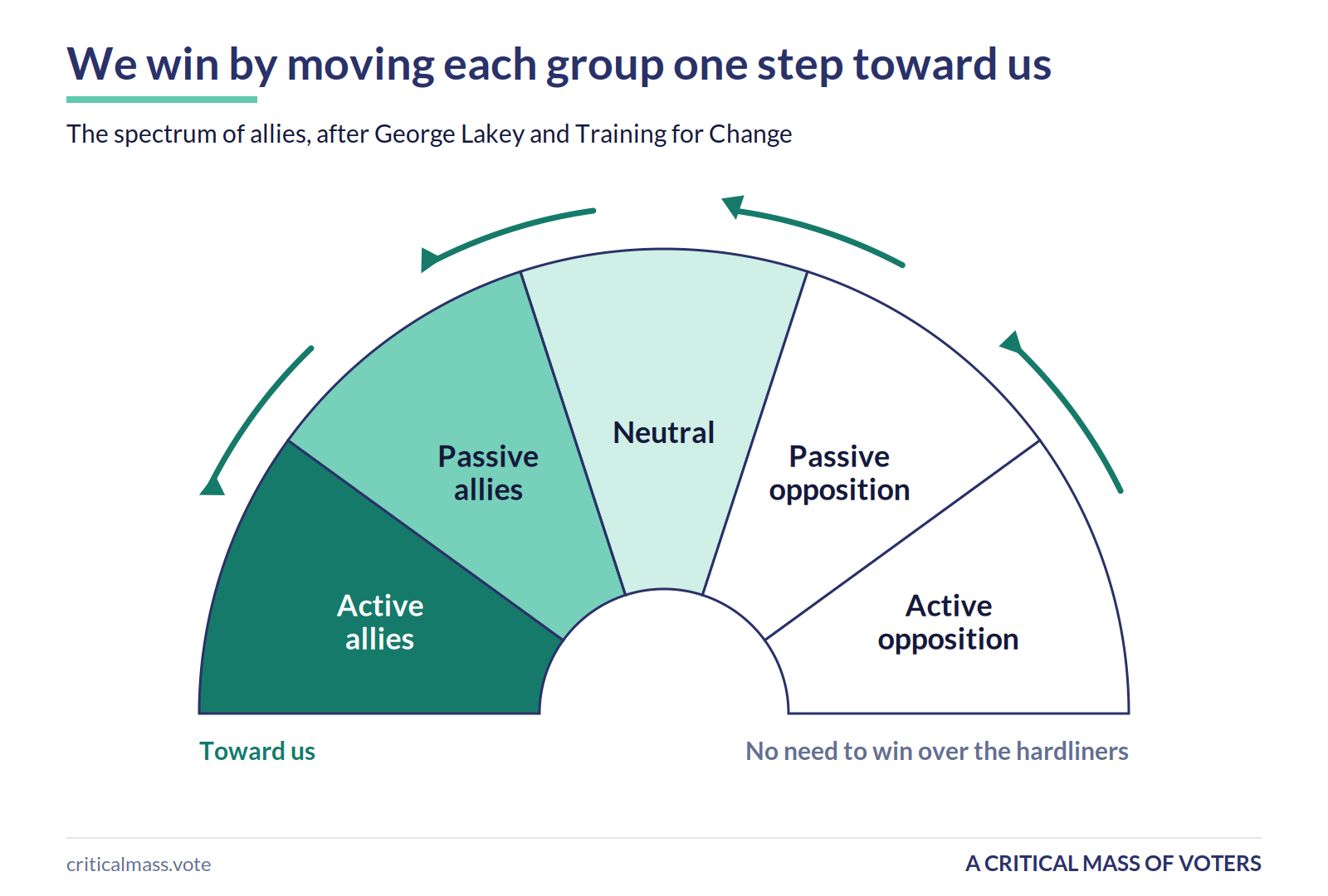
Most defections are small: a county lawyer who won’t defend the sheriff, a prosecutor who won’t bring a case without evidence, or a Farm Bureau chief that tells Trump he’s selling out the country’s ranchers. Each of these is an example of someone inside a pillar of society deciding not to go along.
Right now, our farm communities are showing us what these defections look like at scale.
Farmers and Ranchers Are Breaking With Trump Over Beef
In late August, Trump announced a plan to bring in cheap foreign beef to lower grocery prices before the midterms. His plan backfired.
The American Farm Bureau Federation and three national cattle associations urged him “to reverse course.” Kansas Farm Bureau President Glenn Brunkow accused him of “selling out American farmers and ranchers to buy votes in November.” Fox’s Tomi Lahren posted that “[i]mporting a bunch of foreign beef” won’t help ranchers. Montana Senator Tim Sheehy warned that the plan hurts ranchers, “most of whom are MAGA Republicans.”
Trump signed the plan anyway. Less than two weeks later, he signed executive orders that NPR called “an olive branch” to ranchers, with policies they’d wanted for years.
None of these groups has left Trump’s coalition entirely. We don’t need them to. Each moved one step in our direction. Authoritarian power erodes the same way, one public letter and one statement at a time.
And farm country isn’t alone.
Inside the Justice Department. Trump’s “grand conspiracy” probe of his perceived enemies has lost three prosecutors this year, including loyalist Joe diGenova, who resigned and told the New York Post, “If you want indictments where there’s no evidence, you have an ethical problem.”
In the courts. The Supreme Court kept Trump’s mail-ballot rule blocked for the midterms, with only Alito and Thomas dissenting. Trump’s response: “These are not the people I interviewed to serve on the United States Supreme Court.”
Among business leaders. In 2021, few in Arizona’s business community publicly condemned a misguided, election-denier-driven review of Maricopa County’s 2020 ballots, as Leadership Now Arizona co-founder John Fees now points out. This year, sixty Arizona business executives have signed a pledge to back the officials running the election and stand behind legitimate results.
Among faith leaders. In July, clergy from more than 1,500 Christian, Jewish, and Muslim congregations held events in nine states asking election officials to pledge to follow the law. “Loving our neighbors means protecting the rights of our neighbors to vote,” said Bishop Betsey Monnot of the Episcopal Diocese of Iowa.
None of this, on its own, is enough to stop Trump from interfering in our elections. Together, however, it shows that more and more people are refusing to blindly follow Trump’s extreme tendencies.
Riverside’s ballots are safe because voters, a registrar, state officials, and judges each did their part, and a sheriff with armed deputies couldn’t get enough people to go along. In farm country, people who’ve stood with Trump for years told him no, and within two weeks he was offering them concessions.
Power that depends on cooperation can be withdrawn by the people who give it. That includes all of us.